
5 Ways AI-Powered CRMs Can Double Your Sales Team's Productivity
Innodify Admin
Author
Introduction
Imagine your sales team never having to manually update contact records, chase cold leads, or wonder which prospect to follow up with today.
Instead, their CRM does it all automatically, intelligently, and in real time. That's not a dream anymore. That's the power of AI-powered CRM software.
Sales teams across the globe are under increasing pressure to close more deals in less time. According to Salesforce's State of Sales report, sales reps spend only 28% of their week actually selling the rest is eaten up by admin tasks, data entry, and manual follow-ups.
AI in CRM changes this equation dramatically.
In this blog, we explore 5 powerful ways AI CRM software is helping businesses from startups to enterprises double their sales team's productivity. Whether you're evaluating the best AI CRM software or looking for a CRM development company in Surat to build a custom solution, this guide is for you.
1. Intelligent Lead Scoring Focus on Leads That Actually Convert
One of the biggest productivity drains on any sales team is spending hours chasing leads that never convert. Traditional CRMs treat every lead equally. AI-powered CRMs don't.
AI sales automation tools analyze hundreds of data points, including website behavior, email engagement, company size, and past purchase history, to automatically score each lead based on their likelihood to convert.
Your reps see a clear priority list every morning:
Who to call first
Who needs a nurture sequence
Who to drop
Real-World Example
HubSpot's AI-powered lead scoring uses predictive analytics to rank contacts automatically. A SaaS company using HubSpot reported a 35% increase in qualified pipeline within 3 months simply because reps stopped wasting time on low-intent leads.
Key Benefits
No more guesswork on which leads deserve attention
Reps spend more time selling, less time sorting
Conversion rates improve because effort is directed correctly
2. Automated Follow-Ups & Email Sequences Never Let a Deal Go Cold
Following up consistently is the #1 difference between a closed deal and a missed opportunity. Studies show that 80% of sales require at least 5 follow-up touches, yet most reps give up after just 2.
AI CRM software eliminates this problem.
With AI in CRM, automated workflows trigger personalized follow-up emails, SMS messages, or reminders based on specific prospect behaviors.
Did a lead open your proposal email twice but not reply? The AI detects this intent signal and automatically schedules a follow-up call or sends a personalized nudge.
Real-World Example
Zoho CRM's AI assistant, Zia, monitors deal activity and alerts reps when a prospect is going cold, suggesting the best time to reach out and which communication channel to use. Businesses using Zia reported saving up to 4 hours per rep per week on manual follow-up tasks.
Key Benefits
Personalized follow-ups sent at the right time, automatically
Behavioral triggers ensure no warm leads fall through the cracks
Reps focus on conversations, not calendar reminders
3. AI-Powered Sales Forecasting Plan Smarter, Sell Better
Traditional sales forecasting is often a gut-feel exercise that managers rely on, including weekly check-ins and outdated spreadsheets.
AI-powered CRM changes this with data-driven forecasting that is accurate, real-time, and actionable.
AI sales automation tools analyze your entire deal history, current pipeline velocity, rep performance, seasonality trends, and external market signals to generate a reliable revenue forecast.
Managers can instantly see:
Which deals are at risk
Which are on track
Where the team needs to double down
Real-World Example
A logistics company in India integrated a custom AI CRM solution built by Innodify, a CRM development company in Surat, which analyzed deal stages, rep activity, and seasonal patterns.
Their forecast accuracy improved from 62% to 89% in the first quarter, allowing leadership to make confident hiring and budgeting decisions.
Key Benefits
Accurate revenue predictions replace guesswork
Managers get early warnings on at-risk deals
Strategic decisions backed by real data, not assumptions
4. Eliminating Data Entry Gives Reps Back Their Selling Time
Ask any salesperson what they hate most about their job, and manual data entry will be near the top.
Logging calls, updating contact info, recording meeting notes, and tagging deals correctly consume hours every week.
AI CRM for small business and enterprise teams alike solves this beautifully.
Modern AI-powered CRMs automatically capture data from:
Emails
Calls
LinkedIn messages
Calendar events
They transcribe call recordings, extract key action items, update deal stages, and even suggest next steps all without any manual input from your rep.
Real-World Example
A real estate company using a custom AI CRM solution built by Innodify saw its reps reclaim an average of 6 hours per week previously spent on manual data updates.
That's over 300 extra selling hours per rep per year, the equivalent of hiring an additional salesperson without extra payroll.
Key Benefits
Auto-logging of calls, emails, and meetings
AI-generated meeting summaries and next-step suggestions
Error-free, always up-to-date pipeline data
5. Personalized Customer Insights
In today's market, generic pitches don't work. Buyers expect you to understand their business, challenges, and goals before you even pick up the phone.
AI in CRM makes hyper-personalization achievable at scale.
The best AI CRM software analyzes your entire customer history, including:
Previous purchases
Support tickets
Website interactions
Social media signals
Industry trends
This gives each sales rep a 360-degree view of every contact.
AI suggests:
Which product to pitch
Which pain point to lead with
The best tone to use
Real-World Example
An eCommerce business using an AI-powered CRM integrated with its Shopify store was able to identify high-value customers about to churn and automatically trigger personalised win-back offers.
This reduced churn by 22% in 60 days without any additional marketing spend.
Key Benefits
360-degree customer profiles built automatically from all touchpoints
AI recommends the right product, message, and timing
Personalisation at scale without added headcount
Traditional CRM vs. AI-Powered CRM: A Quick Comparison!
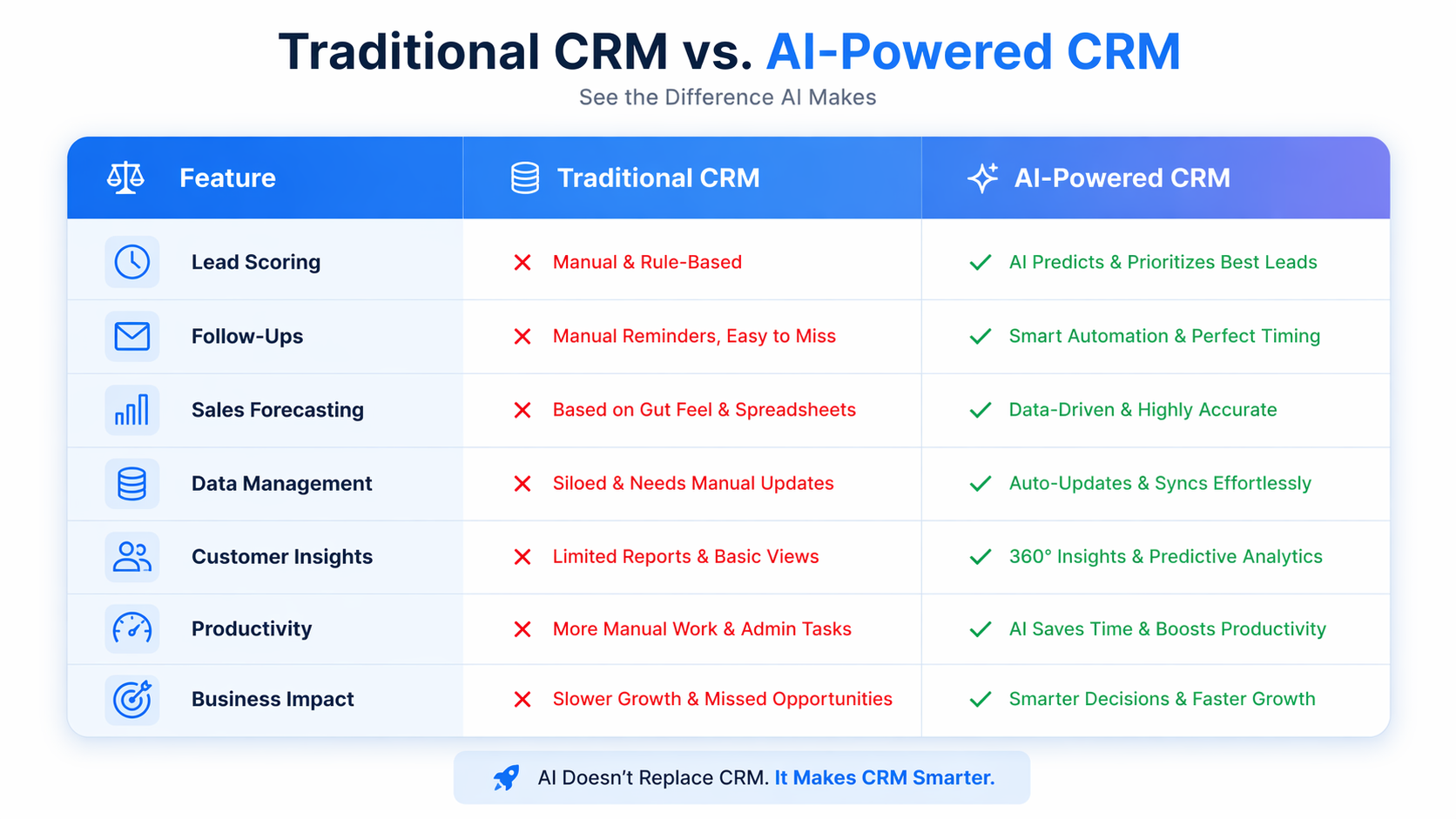
Traditional CRM vs AI-Powered CRM
Conclusion: The Future of Sales Is AI-Driven
The sales landscape is evolving fast. Companies that embrace AI-powered CRM software today will have a significant competitive advantage not just in efficiency, but in customer experience and revenue growth.
From intelligent lead scoring and automated follow-ups to accurate forecasting and hyper-personalization, AI in CRM removes the friction that slows down sales teams.
Whether you're a 5-person startup or a 500-person enterprise, the right AI CRM for small business or large teams can truly double your team's output without doubling headcount or budget.
The question isn't whether you should adopt an AI-powered CRM, it's how fast you can get started.
Ready to Transform Your Sales Process?
Innodify is a leading CRM development company in Surat specializing in custom AI CRM solutions tailored to your business workflow.
We have helped businesses across real estate, e-commerce, fintech, and logistics automate their sales pipeline and close deals faster.
Let's build your AI-powered CRM:
CRM Development Agency in Surat
Frequently Asked Questions (FAQs)
What is an AI-powered CRM?
An AI-powered CRM is a customer relationship management system that uses artificial intelligence to automate tasks like lead scoring, follow-ups, data entry, and sales forecasting. Unlike traditional CRMs, AI CRM software learns from your data to provide intelligent insights and recommendations helping sales teams work faster and smarter.
What is the best AI CRM software for small businesses?
Popular options include HubSpot CRM (with AI features on paid plans), Zoho CRM with Zia AI, and Salesforce Einstein. However, for businesses with specific workflows or industry needs, a custom AI CRM solution built by a specialist agency like Innodify can offer far better ROI and flexibility than off-the-shelf tools.
How does AI in CRM improve sales productivity?
AI in CRM improves productivity in several key ways: it automates repetitive tasks (data entry, follow-ups), prioritizes leads intelligently, generates accurate forecasts, provides personalized customer insights, and surfaces actionable recommendations freeing your reps to focus on high-value conversations and closing deals.
Is AI CRM software suitable for small businesses?
Absolutely. AI CRM for small businesses is one of the most impactful investments a growing company can make. Small teams benefit the most from automation since they often don't have the bandwidth to handle manual CRM tasks. Even basic AI features like automated follow-ups and lead scoring can dramatically improve conversion rates for small sales teams.
How much does it cost to build a custom AI CRM?
The cost of building a custom AI CRM depends on the complexity of features, integrations, and your business size. As a CRM development company in Surat, Innodify offers cost-effective custom solutions compared to expensive Western agencies without compromising on quality. Contact us at Innodify for a tailored quote.
Recommended for you
Top 7 Signs Your Business Needs a New Website
Is your website helping your business grow or driving customers away? An outdated, slow, or non-mobile-friendly website can hurt your credibility, reduce conversions, and lower your Google rankings. In this blog, we explore the top 7 signs that indicate it’s time to redesign or rebuild your business website. From poor user experience and slow loading speeds to weak SEO performance and low lead generation, these warning signs can directly impact your revenue.
Why Surat Businesses Need a Mobile App in 2026 (Real Examples)
Surat businesses across jewellery, restaurants, fashion and services are moving to mobile apps in 2026. Here is why, with real-world examples of how a business mobile app in Surat drives customer retention and growth.
10 Things to Check Before Hiring a Web Development Company in Surat
Hiring the wrong web development agency can cost you time, money, and rankings. Here are 10 things every business owner in Surat should check before signing a contract.