
Custom AI Solutions vs. Off-the-Shelf AI Tools Which Is Right for Your Business
Innodify Admin
Author
Introduction
Artificial Intelligence (AI) is no longer a futuristic concept it has become an essential part of modern business operations. From automating repetitive tasks to improving customer service and making data-driven decisions, AI is helping businesses gain a competitive edge.
However, one important question remains:
Should you invest in custom AI solutions or rely on off-the-shelf AI tools?
While ready-made AI platforms offer convenience, they often fail to address unique business challenges. This is where custom AI solutions come into play, offering personalized automation and intelligence tailored to your organization's specific goals.
In this blog, we'll compare both approaches in depth, walk through how custom AI is actually built, look at the real costs and ROI involved, and help you decide which option is best for your business.
What Are Custom AI Solutions?
Custom AI solutions are AI-powered applications specifically designed and developed for a business's unique requirements. Instead of adapting your business processes to fit generic software, custom AI adapts to your existing workflows.
These solutions can include:
AI Chatbots
Predictive Analytics
AI Document Processing
Recommendation Engines
Intelligent Automation
AI Voice Assistants
AI-powered CRM Systems
Business Intelligence Dashboards
Unlike generic software, these systems are built exclusively for your business objectives.
What Are Off-the-Shelf AI Tools?
Off-the-shelf AI tools are pre-built software products that anyone can subscribe to and start using immediately. Common examples include:
AI writing assistants
AI customer support platforms
AI image generators
AI meeting assistants
AI analytics software
These tools require minimal setup and are ideal for businesses with standard requirements. However, they often have limited customization options and may not integrate seamlessly into existing business processes.
The Hidden Costs of Off-the-Shelf AI Tools
On the surface, off-the-shelf AI tools look like the cheaper option, but the real cost often shows up later. Most platforms charge per user or per usage tier, so monthly fees quietly climb as your team and customer base grow. Many businesses end up paying for several overlapping subscriptions just to cover gaps that a single tailored system could have handled from the start.
A few hidden costs worth watching for:
Per-seat or per-usage pricing that scales faster than expected as your team grows
Multiple overlapping subscriptions needed to cover one workflow
Data stored on shared infrastructure, making migration difficult later
Business processes bent to fit the tool's limitations instead of the other way around
These costs are easy to overlook until they start slowing your team down.
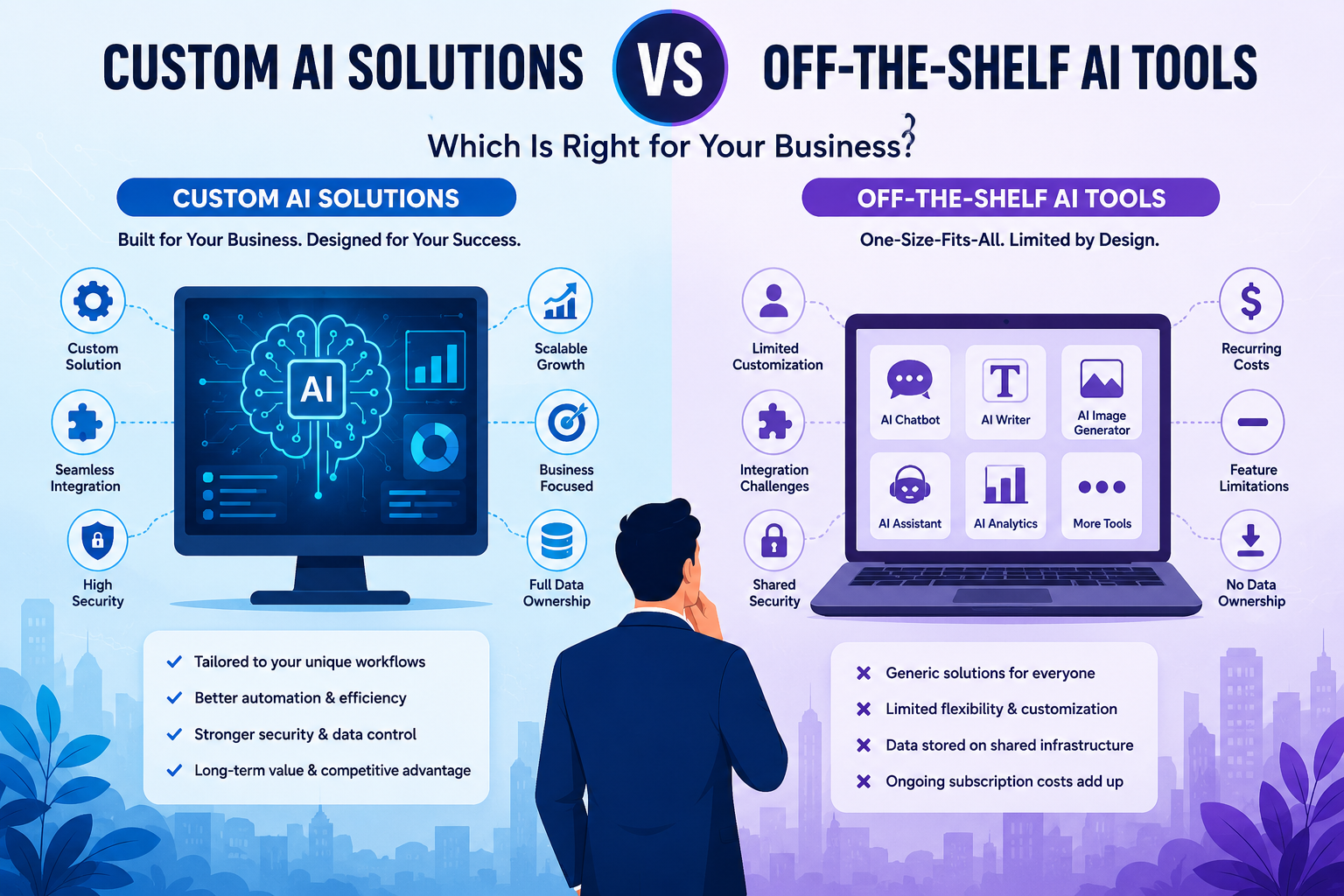
Custom AI Solutions vs Off-the-Shelf AI Tools
Businesses looking for long-term growth often benefit more from custom AI development than generic AI subscriptions.
Why Businesses Are Choosing Custom AI Solutions
Every company has different workflows, customers, and business goals. Generic AI tools try to serve everyone, but they rarely solve industry-specific problems. That's why companies are investing in AI business solutions tailored to their exact requirements.
This shift is already visible in the numbers. According to the 2026 U.S. Chamber of Commerce Small Business Survey, 89% of small businesses are now using AI in some form, up sharply from just 36% in 2023. As more businesses move past basic experimentation, many are finding that generic tools only take them so far, which is pushing serious adopters toward more tailored solutions.
Benefits include:
Better automation
Faster workflows
Higher accuracy
Better customer experience
Increased productivity
Reduced operational costs
Improved business insights
Custom AI becomes a strategic asset rather than just another software subscription.
How Custom AI Solutions Are Built: The Development Process
Understanding how custom AI is actually developed helps set realistic expectations for cost and timeline. The process usually follows a few key stages:
Discovery – studying your workflows, data sources, and pain points to identify where AI can add real value
Architecture and model selection – choosing between training a model on your own data, fine-tuning an existing foundation model, or combining several AI techniques
Integration – connecting the solution with your current software stack
Testing and refinement – validating performance against real business scenarios rather than assumptions
Deployment and monitoring – rolling the system out and continuing to retrain it as new data comes in
A poorly scoped discovery phase is one of the most common reasons custom AI projects fall short, so it's worth giving this step real attention before development begins.
Benefits of Working with a Custom AI Solutions Company
Partnering with a professional custom AI solutions company provides access to AI expertise that most businesses don't have internally.
Such companies analyze your processes and build AI models specifically designed for your industry.
Personalized Development
Every feature is created around your business objectives.
Better Integration
Custom AI integrates with:
CRM
ERP
Accounting Software
HR Systems
E-commerce Platforms
Inventory Systems
without disrupting existing workflows. If your business also needs a modern, custom-built website or customer-facing platform to fully take advantage of these integrations, our web development services can help you build a scalable digital foundation.
Data Security
Your business data remains protected through private infrastructure instead of shared public AI platforms.
Continuous Improvement
Custom AI models continue learning and improving as more business data becomes available.
Why Custom AI Solutions for Small Business Are Becoming Popular
Many people believe AI is only for large enterprises. That is no longer true. Today, custom AI solutions for small business are affordable and highly scalable.
A February 2026 survey by the Small Business Expo Research Desk found that 71.4% of small businesses are now actively using AI in some capacity. Among those users, 78.6% reported that it had reduced costs or improved efficiency. The gains aren't just theoretical; they're already showing up on the bottom line for businesses that move beyond basic experimentation.
Small businesses can automate:
Customer support
Appointment scheduling
Lead qualification
Email responses
Social media management
Sales reporting
Inventory management
Invoice processing
This allows business owners to focus on growth rather than repetitive administrative tasks, helping small teams achieve enterprise-level productivity.
Industries Using AI Business Solutions
Almost every industry is adopting AI.
Healthcare: patient scheduling, medical diagnosis support, AI chatbots
Finance: fraud detection, risk analysis, loan approvals
Retail: product recommendations, inventory forecasting, customer segmentation
Manufacturing: predictive maintenance, quality control, supply chain optimization
Education: personalized learning, AI tutoring, automated grading
Real Estate: property recommendations, lead generation, virtual assistants
These AI business solutions help companies improve efficiency while reducing operational costs.
Common Myths About Custom AI Solutions
A few misconceptions still hold businesses back from exploring custom AI, and most of them don't hold up under closer examination.
"Custom AI is only for large enterprises." Modern AI frameworks and cloud infrastructure have brought development costs down significantly, making tailored solutions accessible to small and mid-sized businesses too.
"Implementation takes months of disruption." Most custom AI projects are rolled out in phases, so existing operations keep running while new capabilities are added gradually.
"AI will replace our employees." In most real-world deployments, AI takes over repetitive, time-consuming tasks so employees can focus on higher-value work, rather than eliminating roles entirely.
How to Measure the ROI of AI Solutions
Because custom AI involves a higher upfront investment, businesses naturally want to know how to measure the return. The numbers from recent research are encouraging: Salesforce found that 91% of small businesses using AI report revenue increases, and Business.com's 2026 data shows the average small business owner now saves around 5.6 hours per week after adopting AI tools.
A few practical ways to track ROI on your own implementation:
Time saved on manual tasks, measured against pre-AI baselines
Drop in operational costs within the first few months of deployment
Fewer errors in processes like invoicing or data entry
Faster response times and improved customer satisfaction scores
Better business insights that support faster, more informed decisions
Over the long term, the insights an AI system generates are often the most valuable return, helping leadership make decisions a generic tool simply isn't positioned to support.
Key Factors to Consider Before Choosing an AI Implementation
Before committing to either path, it helps to assess a few practical factors:
Budget and timeline – a quick off-the-shelf subscription vs. a phased custom build
Data readiness – AI is only as effective as the data it's trained on, so messy or scattered data may need cleanup first
Growth plans – a tool that fits today's team size may not scale well with rapid growth
In-house technical capacity – how much ongoing management your team can realistically support
Being honest about these factors upfront usually points clearly toward the right path.
When Off-the-Shelf AI Tools Make Sense
Ready-made AI tools still have their place. They are suitable for:
Freelancers
Individual creators
Small teams
Temporary projects
Content creation
Basic automation
If your requirements are simple and standard, these tools can provide quick value without significant investment. However, they may become restrictive as your business grows.
When Should You Choose Custom AI Solutions?
Custom AI is ideal when:
Your business has unique workflows
You need AI integrated with existing systems
Security is a top priority
You need industry-specific automation
You want a competitive advantage
You process large amounts of business data
You want long-term scalability
In these situations, custom AI solutions deliver far greater value than generic AI software.
Why Not Every Business Needs Custom AI
As compelling as custom AI sounds, it isn't automatically the right move for every business, and pretending otherwise does a disservice to companies that would be better served by a simpler tool. The data backs this up: RAND Corporation's analysis of more than 2,400 enterprise AI initiatives found that over 80% fail to deliver their intended business value, roughly twice the failure rate of standard IT projects.
Gartner has gone further, predicting that 60% of AI projects without properly organized, AI-ready data will be abandoned by the end of 2026. Most of these failures trace back to unclear goals, messy data, or jumping into a custom build before the groundwork is in place, not to the technology itself.
Custom AI is probably premature if any of the following sound familiar:
An off-the-shelf tool already covers most of what you need, and the missing 10-20% isn't worth a large custom build
Your business data is scattered across spreadsheets, paper records, or disconnected - - systems with no plan to clean it up
You don't have the budget or team to support ongoing monitoring and retraining after launch
Your processes are still changing quickly, so a system built today may not match how you operate a year from now
You're testing a new business model or product line and need to move fast rather than build for scale
In these cases, starting with a ready-made tool isn't a compromise. It's often the smarter first step, one that buys time to figure out exactly what a custom solution would need to do before committing real budget to it.
How to Choose the Right Custom AI Solutions Company
Not every AI vendor is the right fit for every business, so it's worth evaluating a few things before signing on:
Industry experience – domain knowledge often matters as much as technical skill
Track record – ask to see examples of past projects and outcomes
Process transparency – vague answers about timelines or methodology are a warning sign
Post-deployment support – AI models need ongoing monitoring and retraining as data and business needs evolve
A custom AI solutions company that offers long-term support will deliver far more value than one that disappears after the initial handoff.
Future of Custom AI Solutions
The future of AI lies in personalization. Businesses increasingly want AI systems that understand their customers, products, and internal processes. Instead of using identical AI software as competitors, organizations are building proprietary AI capabilities that create sustainable competitive advantages.
Emerging trends like agentic AI, which allows systems to carry out multi-step tasks with minimal human input, and multimodal AI, which can process text, images, and voice together, are pushing custom development even further ahead of generic tools. Experts predict that custom AI adoption will accelerate as businesses seek smarter automation and personalized decision-making. Companies investing today will likely become market leaders tomorrow.
Conclusion
Artificial intelligence is transforming every industry, but choosing the right implementation strategy is critical.
Off-the-shelf AI tools offer convenience and affordability, making them ideal for basic tasks and startups with limited requirements.
However, businesses seeking long-term growth, deeper automation, and competitive differentiation should consider investing in custom AI solutions.
A trusted custom AI solutions company can develop intelligent systems tailored to your operations, helping you improve efficiency, reduce costs, and unlock new opportunities.
Whether you're a startup, enterprise, or looking for custom AI solutions for small business, tailored AI business solutions provide the flexibility and scalability needed to thrive in the AI-driven future.
FAQs
What are custom AI solutions?
Custom AI solutions are AI applications built specifically for a business's unique processes, goals, and operational requirements.
Are custom AI solutions expensive?
While initial development costs may be higher than subscription-based tools, they often provide better long-term ROI through automation and efficiency gains.
Why choose a custom AI solutions company?
A professional custom AI solutions company develops AI systems tailored to your business, ensuring better integration, scalability, and performance.
Can small businesses benefit from AI?
Yes. Custom AI solutions for small businesses help automate repetitive tasks, improve customer service, and increase productivity without requiring large teams.
How long does it take to build a custom AI solution?
Timelines vary by complexity, but most custom AI projects are delivered in phases over a few weeks to a few months, allowing businesses to start seeing value before the full system is complete.
Which is better: Custom AI or off-the-shelf AI tools?
If your business has unique requirements and plans for long-term growth, custom AI solutions generally provide greater value than generic AI tools.
Recommended for you
Top 7 Signs Your Business Needs a New Website
Is your website helping your business grow or driving customers away? An outdated, slow, or non-mobile-friendly website can hurt your credibility, reduce conversions, and lower your Google rankings. In this blog, we explore the top 7 signs that indicate it’s time to redesign or rebuild your business website. From poor user experience and slow loading speeds to weak SEO performance and low lead generation, these warning signs can directly impact your revenue.
Why Surat Businesses Need a Mobile App in 2026 (Real Examples)
Surat businesses across jewellery, restaurants, fashion and services are moving to mobile apps in 2026. Here is why, with real-world examples of how a business mobile app in Surat drives customer retention and growth.
10 Things to Check Before Hiring a Web Development Company in Surat
Hiring the wrong web development agency can cost you time, money, and rankings. Here are 10 things every business owner in Surat should check before signing a contract.