
D2C Brand Website Development: What Makes a High-Converting Store?
Innodify Admin
Author
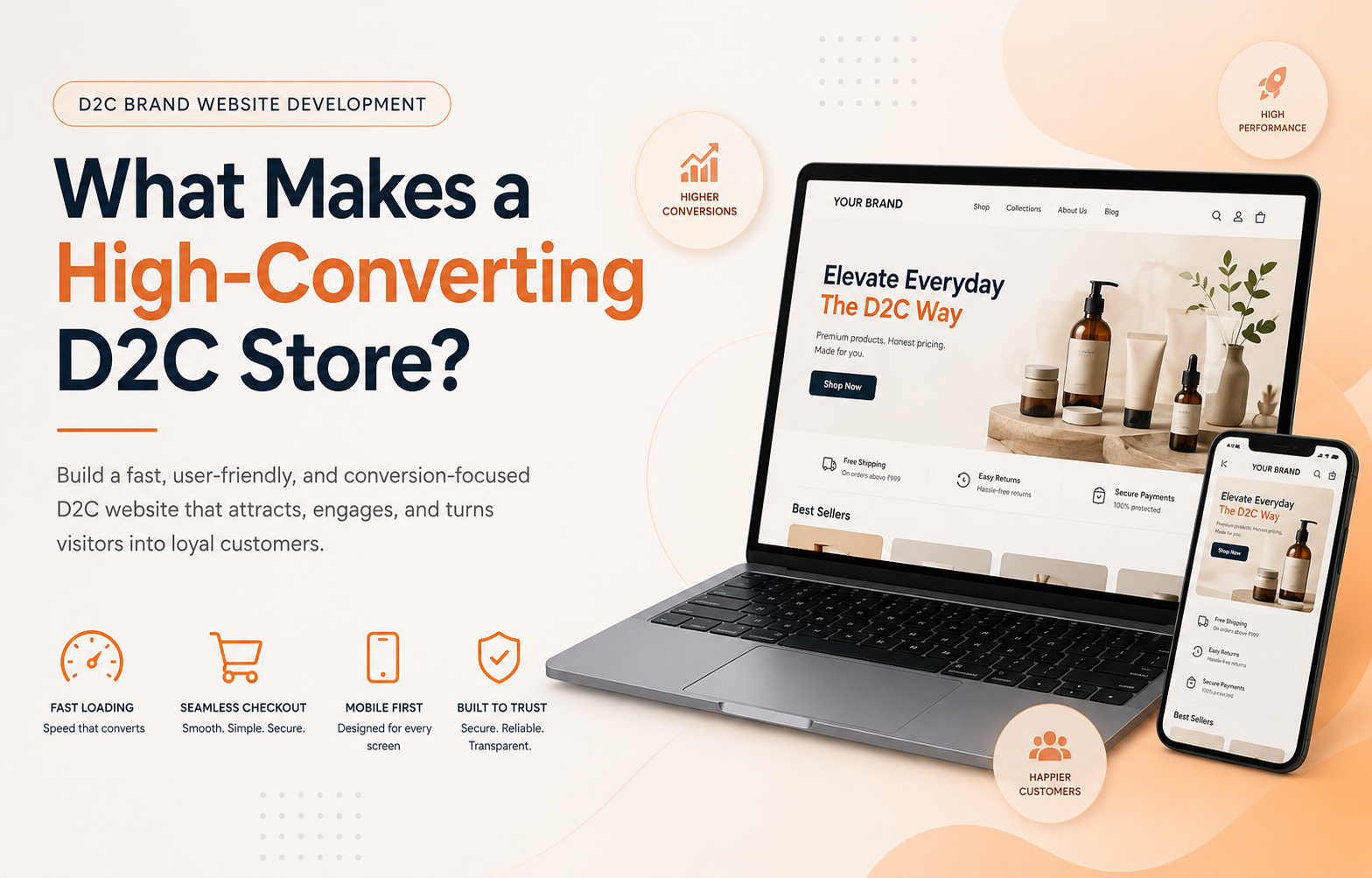
The direct-to-consumer model has fundamentally changed how brands sell online. With no intermediaries in the picture, your website isn't just a storefront it's your entire sales team, customer service desk, and brand ambassador rolled into one. That's why website development for D2C brands demands a completely different approach compared to building a generic e-commerce site.
If you're a small business owner, a founder launching your first product, or a growing brand hitting a conversion ceiling this guide breaks down exactly what separates a high-converting D2C store from one that bleeds traffic without ever turning visitors into buyers.
Why D2C Website Development Is a Different Game
Traditional retail brands push products through distributors and third-party platforms. D2C brands cut that chain entirely which means every element of your website must do the heavy lifting: building trust, communicating value, answering objections, and making the purchase feel effortless.
E-commerce web development for D2C brands is as much about psychology and performance as it is about design. A slow page, a confusing checkout, or a vague product description can kill a conversion in seconds and with customer acquisition costs climbing across all paid channels, you can't afford that kind of leakage.
What makes D2C particularly demanding is the full-funnel responsibility your website carries. On Amazon or Flipkart, the platform handles trust, discovery, and payment infrastructure. When you go direct, all of that falls on your site. That's a significant responsibility and an even bigger opportunity.
1. Speed Is a Non-Negotiable Foundation
Page speed isn't a technical afterthought it's a conversion lever. Research consistently shows that even a one-second delay in load time can reduce conversions by 7%. For mobile-first D2C brands, this gap is even wider.
A high-converting D2C store is built for performance from the ground up:
Compressed, next-gen image formats (WebP over PNG/JPEG)
Lazy loading for below-the-fold content
Minimal third-party scripts and tag bloat
CDN delivery for fast load times across regions
Core Web Vitals scores that meet Google's thresholds (LCP, CLS, INP)
Whether you're on Shopify, WooCommerce, or a custom stack built with Next.js or React, speed optimisation must be baked into the development process not patched in after launch.
2. Brand Storytelling Built Into the UX
D2C brands win on story. Unlike marketplace sellers competing on price, D2C businesses compete on connection with their values, their origin, and the lifestyle they represent.
Your website development needs to carry that story through every scroll:
The homepage should communicate your brand's "why" within the first three seconds
Product pages should explain how the product fits into the customer's life not just list specs
About pages that feel personal rather than corporate
Photography and copy that reinforce a consistent brand identity throughout
This is where working with a D2C website development company that understands brand positioning (not just code) makes a genuine difference. A developer who only thinks in components will miss the narrative gaps that quietly push customers away.
3. Product Pages That Convert, Not Just Inform
The product page is where the buying decision happens. Most D2C brands underinvest here and overspend on ad traffic, a costly mismatch that keeps CAC high and ROAS low.
A high-converting product page typically includes:
Above the fold:
Strong product imagery (multiple angles, lifestyle shots, short video)
Clear, benefit-led headline, not just the product name
Price with savings, bundles, or subscription options surfaced upfront
A prominent, friction-free CTA button
Below the fold:
In-depth descriptions that speak to real customer pain points
Social proof: reviews, ratings, and user-generated content
Ingredients, materials, or specs in scannable format
A short FAQ addressing common objections
Complementary product suggestions to increase average order value
Every unanswered question on a product page is a potential lost sale.
4. Trust Architecture Across the Entire Funnel
First-time buyers are sceptical by default. D2C brands, especially newer ones, don't have the brand recognition of legacy retailers so trust must be earned quickly and maintained throughout the journey.
Effective ecommerce web development for D2C builds trust signals into the architecture itself:
Security indicators: SSL certificate, secure payment badges, HTTPS sitewide
Social proof: Reviews, testimonials, press mentions, and real numbers ("10,000+ happy customers")
Transparent policies: Clear returns, shipping timelines, and support access prominently placed, not buried in footers
Founder visibility: A real face behind the brand goes a long way for early-stage D2C companies
Live chat or WhatsApp integration: Real-time support availability signals that someone is there if something goes wrong
Trust isn't a section of the site it's a layer that runs across every page.
5. Checkout Experience Engineered for Completion
Cart abandonment rates average around 70% across e-commerce globally. For D2C brands, the checkout is the single highest-leverage page on the site and most brands treat it as an afterthought.
A conversion-optimised checkout should:
Offer guest checkout (no forced account creation)
Show a clear progress indicator for multi-step flows
Support multiple payment options — cards, UPI, wallets, COD, and BNPL
Display trust signals and return policy reminders at the payment step
Minimise form fields — ask only what's needed
Be fully optimised for mobile thumb navigation
Auto-fill address fields using pincode lookup
Upsells work well at checkout too but only when they're relevant and don't interrupt the purchase flow.
6. Mobile-First, Always
Over 65–70% of D2C ecommerce traffic in India comes from mobile. Yet many brands still design for desktop and "optimise" for mobile as a secondary step, leading to cluttered layouts, oversized buttons, and checkout flows that frustrate users on small screens.
True mobile-first development means designing the mobile experience first, then scaling up to desktop. This affects everything: navigation structure, image sizing, CTA placement, font legibility, and tap target sizes.
A specialist D2C website development company will treat mobile UX as the primary design constraint, not a responsive afterthought.
7. Personalisation and Retention Features
High-converting D2C stores don't just acquire customers they retain them. Website development for D2C brands increasingly includes features that encourage repeat purchases:
Account dashboards with order history, loyalty points, and reorder shortcuts
Wishlist functionality so browsers can return to saved products
Subscription or auto-replenishment options for consumables
Personalised product recommendations based on browsing or purchase history
Post-purchase email/SMS capture built into the thank-you page
Retention-focused features turn a transactional store into a brand ecosystem and they're far more cost-effective than constantly acquiring new customers.
8. SEO Architecture Built for Organic Growth
Paid ads can launch a D2C brand, but organic search is what makes it sustainable. Your website development for D2C brands needs to lay the right SEO foundation from day one:
Clean, keyword-aligned URL structures for products and collections
Schema markup for products, reviews, and FAQs
Optimised meta titles and descriptions at scale
Blog or content hub infrastructure for building topical authority
Canonical tags to prevent duplicate content from filters and variants
Fast-loading, fully indexable pages across the catalogue
D2C brands that invest in SEO-forward development early build a compounding traffic asset one that keeps working long after your ad budget stops.
9. Analytics and CRO Infrastructure
You can't improve what you can't measure. High-converting D2C stores are built with conversion rate optimisation in mind from the start:
Google Analytics 4 (GA4) with full ecommerce event tracking
Heatmapping tools (Hotjar, Microsoft Clarity) to see real user behaviour
A/B testing capability on high-impact pages, homepage hero, product pages, checkout
Funnel visibility to identify exactly where users drop off
Email and SMS capture integrated at the right moments (exit intent, post-purchase)
This infrastructure transforms your website from a static storefront into a constantly improving conversion engine.
Why Small Business Owners Need the Right Development Partner
If you're a small business owner going D2C, the stakes are even higher. You don't have a large team to patch things up after a bad launch, or a big budget to keep throwing at ads, hoping something sticks. Your website has to work from day one.
That means you need a development partner who brings both technical depth and e-commerce thinking to the table. Someone who understands conversion, not just code.
Innodify is a Surat-based, award-winning digital agency that has helped businesses across industries build high-performance web experiences from e-commerce stores and SaaS platforms to AI-powered solutions. With a full-stack team skilled in Next.js, React, and Node.js, Innodify builds fast, SEO-ready, mobile-first websites that are designed to convert visitors into customers.
Whether you're launching your first D2C store or rebuilding an underperforming one, their web development services are built for brands that need results not just a good-looking website. They've delivered projects across real estate, ecommerce, edtech, and fintech, which means they bring cross-industry thinking to every D2C build.
If you're a small business owner serious about going direct-to-consumer, starting the conversation with a team like Innodify is worth your time.
Frequently Asked Questions
1. What is D2C website development?
D2C (Direct-to-Consumer) website development is the process of creating an e-commerce website that enables brands to sell directly to customers without relying on marketplaces like Amazon or Flipkart. A professionally developed D2C website includes features such as mobile-first design, fast loading speeds, secure payment gateways, SEO optimisation, customer account management, and a smooth checkout process. Unlike a standard e-commerce site, a D2C website focuses on building long-term customer relationships, increasing brand loyalty, and maximising conversion rates.
2. Which platform is best for D2C website development?
The right platform depends on your business goals and budget. Shopify is an excellent choice for startups and growing brands because it is easy to manage, secure, and scalable. WooCommerce is ideal for businesses already using WordPress and looking for greater customisation. Custom development using technologies like Next.js or React is suitable for businesses that require advanced functionality, unique user experiences, or enterprise-level scalability. Choosing the right platform should also consider your expected traffic, integrations, and future growth plans.
3. How long does it take to develop a D2C ecommerce website?
The timeline depends on the complexity of the project. A standard Shopify website with essential e-commerce features usually takes around 3–6 weeks to complete. A more customised e-commerce website with advanced integrations, custom UI/UX, and additional features may require 8–12 weeks or longer. Proper planning, content preparation, and timely feedback can help speed up the development process and ensure a successful launch.
4. What features should every high-converting D2C website include?
A successful D2C website should include fast page loading, responsive mobile design, intuitive navigation, high-quality product pages, secure checkout, multiple payment options, customer reviews, trust badges, SEO-friendly architecture, and analytics integration. Features like personalised product recommendations, live chat, wishlist functionality, and abandoned cart recovery can further improve user experience and increase conversions.
5. Why is SEO important for D2C websites?
SEO helps D2C brands attract potential customers through organic search without relying entirely on paid advertising. An SEO-friendly website includes optimized URLs, fast loading pages, schema markup, keyword-rich content, image optimization, and proper internal linking. Investing in SEO during website development creates a strong foundation that can generate consistent traffic, improve search rankings, and reduce long-term customer acquisition costs.
6. Why should I hire a professional D2C website development company?
A professional D2C website development company understands how to combine design, technology, SEO, and conversion optimization into a single high-performing ecommerce website. Experienced developers can build a fast, secure, and scalable store while avoiding common issues such as poor mobile performance, slow loading speeds, and complicated checkout processes. Working with experts also ensures your website is future-ready and designed to support business growth as your brand expands.
Final Thoughts
A high-converting D2C store isn't defined by how it looks it's defined by how it performs. Fast load times, a checkout that doesn't leak, product pages built to close, mobile UX that feels native, and a trust framework that turns strangers into buyers.
The brands that invest in ecommerce web development purpose-built for D2C are the ones building sustainable revenue not just traffic numbers. Every rupee spent on acquisition works harder when your website is engineered to convert.
If you're ready to build a D2C store that actually performs, Innodify's web development team is a strong place to start.
Recommended for you
Top 7 Signs Your Business Needs a New Website
Is your website helping your business grow or driving customers away? An outdated, slow, or non-mobile-friendly website can hurt your credibility, reduce conversions, and lower your Google rankings. In this blog, we explore the top 7 signs that indicate it’s time to redesign or rebuild your business website. From poor user experience and slow loading speeds to weak SEO performance and low lead generation, these warning signs can directly impact your revenue.
Why Surat Businesses Need a Mobile App in 2026 (Real Examples)
Surat businesses across jewellery, restaurants, fashion and services are moving to mobile apps in 2026. Here is why, with real-world examples of how a business mobile app in Surat drives customer retention and growth.
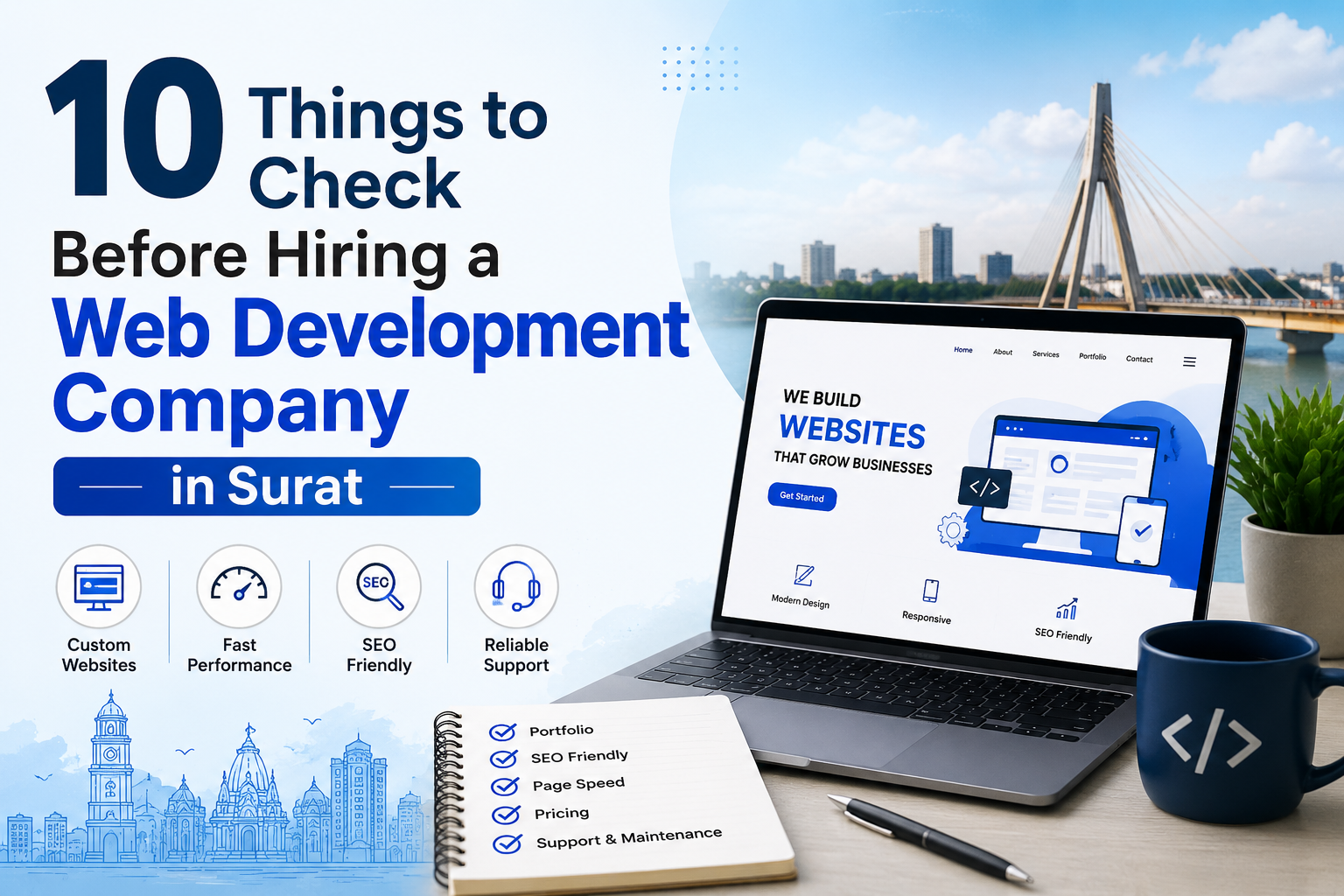
10 Things to Check Before Hiring a Web Development Company in Surat
Hiring the wrong web development agency can cost you time, money, and rankings. Here are 10 things every business owner in Surat should check before signing a contract.