
React vs Next.js: Best Frontend Framework for Business Website
Innodify Admin
Author
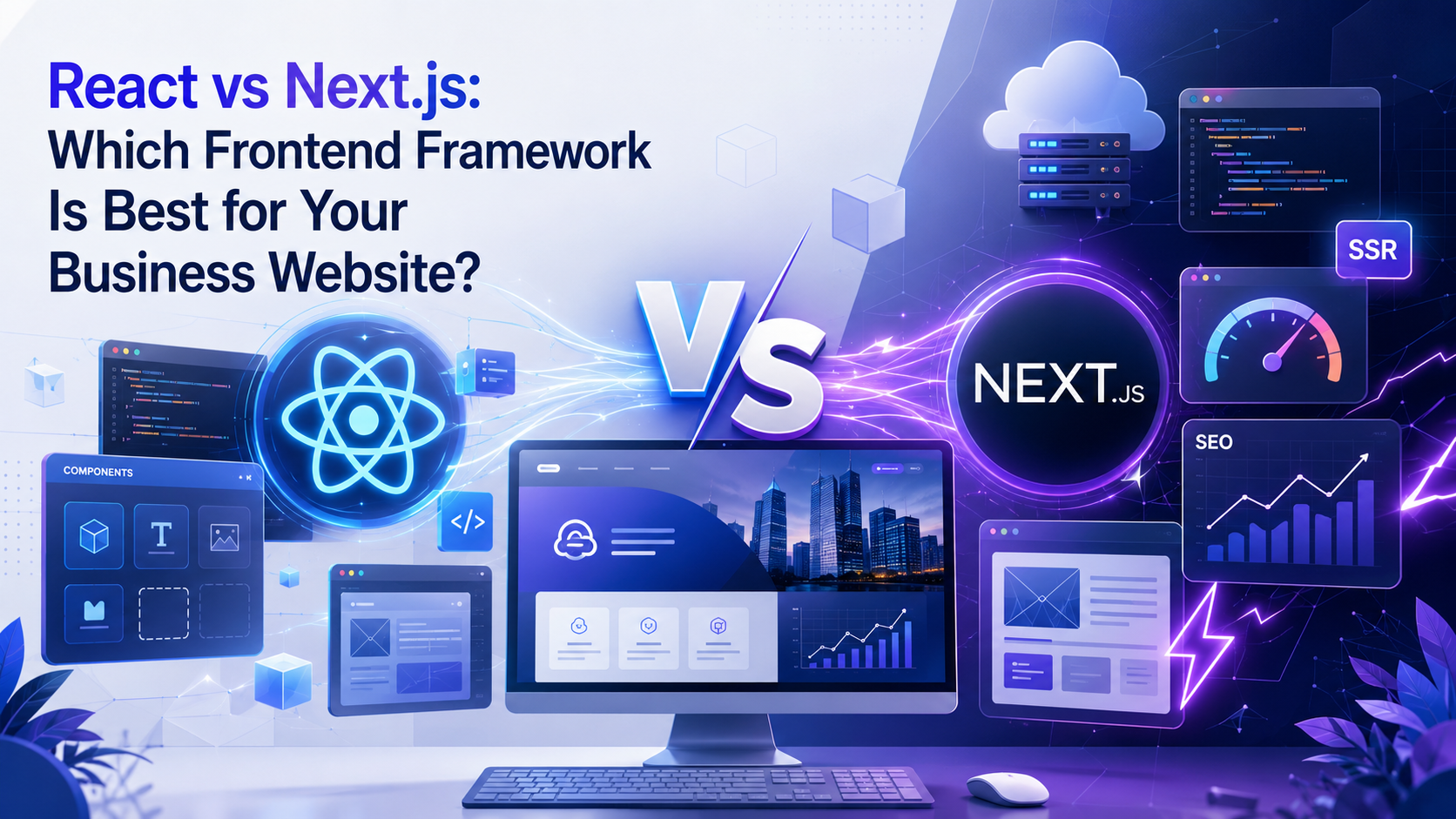
Introduction
Choosing the right frontend development framework is one of the most important decisions when building a modern business website. The framework you choose affects your website's speed, SEO performance, scalability, user experience, and future maintenance.
Many businesses find themselves comparing the React framework and the Next.js framework before starting a project. While both are powerful technologies, they serve different purposes and are suitable for different business needs.
In this guide, we'll compare React vs Next.js in simple terms, helping you understand which option is the best frontend framework for business website projects. Whether you're a startup, a growing business, or an enterprise, this comparison will help you make an informed decision.
What Is React?
The React framework is a popular JavaScript library developed by Meta for building interactive and dynamic user interfaces. It allows developers to create reusable components, making websites faster to develop and easier to maintain.
React is widely used for dashboards, web applications, SaaS platforms, and interactive business solutions. However, React focuses primarily on the user interface, so developers often need additional tools for routing, SEO, and server-side rendering.
If your business requires a highly interactive web application, React offers excellent flexibility and performance.
What Is Next.js?
The Next.js framework is built on top of React and extends its capabilities by adding features that businesses commonly need. These include server-side rendering (SSR), static site generation (SSG), image optimization, file-based routing, and built-in SEO improvements.
Instead of configuring multiple tools separately, Next.js provides everything in one framework. This reduces development time while improving website performance.
For businesses that depend on search engine visibility and fast-loading websites, Next.js has become one of the preferred choices.
React vs Next.js: Key Differences
Although both technologies use React components, their approach is different.
| Features | React Framework | Next.js Framework |
|---|---|---|
| SEO | Requires additional setup | Built-in SEO support |
| Performance | Good | Execellent |
| Server-Side Rendering | No | Yes |
| Static Site Generation | No | Yes |
| Routing | Manual | Built in |
| Image Optimization | Manual | Built in |
| Development Speed | Medium | Faster for Business Website |
| Best For | Web Application | Business Websites & SEO |
Which Framework Performs Better?
Website speed directly affects user experience and Google rankings.
React loads content in the browser after JavaScript executes. While this works well for applications, it may increase loading time for content-heavy websites.
The Next.js framework renders pages on the server before sending them to users. This results in faster loading speeds, improved Core Web Vitals, and better overall performance.
For businesses focused on conversions and customer experience, Next.js usually delivers a noticeable advantage.
React vs Next.js for SEO
SEO is one of the biggest differences between these frameworks.
React websites often require additional configuration to become search engine friendly. Developers need extra tools to ensure pages are properly indexed by Google.
The Next.js framework includes server-side rendering and static site generation, making it much easier for search engines to crawl website content. This helps improve visibility and organic traffic.
If your goal is to attract customers through Google Search, Next.js is generally the better choice.
Which Framework Is Easier to Scale?
As your business grows, your website should grow with it.
The React framework provides excellent flexibility and is widely used for large-scale applications. However, scaling React projects often requires additional libraries and project configuration.
The Next.js framework includes many enterprise-ready features by default, making it easier to manage larger websites without increasing complexity.
For companies planning long-term growth, Next.js offers a more structured development experience.
Development Time and Maintenance
Business owners often overlook maintenance costs.
React projects usually require developers to configure routing, SEO tools, optimization libraries, and deployment strategies manually.
With the Next.js framework, many of these features are already included. This reduces development effort, simplifies maintenance, and allows teams to launch projects faster.
Lower maintenance often translates into lower long-term development costs.
Which Businesses Should Choose React?
React is a great option if your business needs:
Interactive dashboards
SaaS platforms
Internal business tools
Customer portals
Large web applications
React gives developers complete flexibility to build highly customized applications.
Which Businesses Should Choose Next.js?
Next.js is ideal for businesses that need:
Corporate websites
Service-based business websites
E-commerce websites
Startup websites
SEO-focused websites
Landing pages
Marketing websites
For most companies, the Next.js framework provides the right balance of performance, SEO, and scalability.
Why Your Development Partner Matters
Choosing the right technology is only part of building a successful website. Working with an experienced development team ensures your website is optimized for performance, SEO, security, and future growth.
At Innodify, we help businesses build modern, scalable, and high-performing websites using the latest frontend technologies. Whether you need a corporate website, a custom web application, or an enterprise solution, our team focuses on delivering websites that drive measurable business results.
If you're planning a new website or upgrading an existing one, explore our Web Development Services to see how we can help.
If you're also evaluating mobile app technologies, read our comparison of Flutter vs React Native to choose the right framework for your next project.
Final Verdict
When comparing React vs Next.js, there isn't a single answer that fits every business.
The React framework remains an excellent choice for highly interactive applications and custom software where flexibility is the priority.
However, for companies looking for the best frontend framework for business website development, the Next.js framework stands out. Its built-in SEO features, faster performance, server-side rendering, and simplified development process make it an ideal solution for modern business websites.
If your objective is to increase visibility, improve user experience, and create a scalable online presence, Next.js is often the smarter long-term investment.
Frequently Asked Questions
Is React better than Next.js?
Not always. React is better suited for highly interactive web applications, while Next.js is generally the better option for business websites that require strong SEO, faster loading speeds, and better overall performance.
Why is Next.js considered better for SEO?
The Next.js framework supports server-side rendering and static site generation, allowing search engines to crawl and index website content more effectively than a standard React application.
Which is the best frontend framework for business website development?
For most businesses, Next.js is considered the best frontend framework because it combines excellent performance, SEO capabilities, scalability, and developer productivity.
Can I migrate my existing React website to Next.js?
Yes. Since Next.js is built on React, many React projects can be migrated. The migration process depends on your application's complexity and architecture.
Is React still relevant in 2026?
Absolutely. The React framework continues to power thousands of websites and applications worldwide. It remains one of the most popular frontend technologies for modern web development.
Should I hire a web development company for React or Next.js projects?
Working with an experienced web development company in Surat like Innodify ensures your website is built using best practices, optimized for SEO and performance, and designed to support your long-term business goals.
Recommended for you
Top 7 Signs Your Business Needs a New Website
Is your website helping your business grow or driving customers away? An outdated, slow, or non-mobile-friendly website can hurt your credibility, reduce conversions, and lower your Google rankings. In this blog, we explore the top 7 signs that indicate it’s time to redesign or rebuild your business website. From poor user experience and slow loading speeds to weak SEO performance and low lead generation, these warning signs can directly impact your revenue.
Why Surat Businesses Need a Mobile App in 2026 (Real Examples)
Surat businesses across jewellery, restaurants, fashion and services are moving to mobile apps in 2026. Here is why, with real-world examples of how a business mobile app in Surat drives customer retention and growth.
10 Things to Check Before Hiring a Web Development Company in Surat
Hiring the wrong web development agency can cost you time, money, and rankings. Here are 10 things every business owner in Surat should check before signing a contract.