
Flutter vs React Native in 2026: Complete Comparison for Startups (Performance, Cost & Hiring)
Innodify Admin
Author
Introduction
Every startup founder reaches a very important point early in their journey the moment where they need to decide how to actually build their mobile app.
And in 2026, this decision almost always comes down to two frameworks: Flutter and React Native.
If you are currently confused between the two, you are not alone. This is one of the most searched and debated topics in mobile development today. Thousands of startups face this exact decision every year because it directly impacts how fast they can launch, how much they will spend, and how scalable their product will be in the long run.
Thousands of startups face this decision every year because it directly impacts growth, cost, and scalability. Choosing the right technology stack, along with reliable web development services, can make a big difference in long-term success.
What makes this decision even harder is that both Flutter and React Native are no longer experimental tools. They are mature, widely adopted, and trusted by large companies around the world.
So naturally, the question is not about which one is “good” or “bad” anymore.
The real question is much more practical:
Which framework fits your startup’s goals, team structure, and product vision in 2026?
This article breaks down everything in a simple, real-world way so you can make a confident decision without getting lost in unnecessary technical complexity.
Why This Decision Matters More Than Ever
In earlier years, users were more forgiving. Apps could be slightly slow or imperfect, and people would still use them.
That is no longer the case in 2026.
Users now expect apps to be fast, smooth, and intuitive from the very first interaction. If something feels even slightly off, a delay in loading, a lag in scrolling, or a confusing interface, users quickly switch to alternatives.
This is why your technology choice matters more than ever.
Choosing the wrong framework doesn’t just create a technical limitation. It creates real business problems that directly affect growth.
For example, many startups face issues like delayed product launches because development takes longer than expected. Some struggle with hiring because the required skill set is too niche. Others end up spending more money than planned because they need to rewrite parts of the app later due to scalability issues.
The key point is that both Flutter and React Native can build high-quality applications. The real difference lies in how they behave in different business situations.
A Quick Understanding of Flutter and React Native
Before comparing performance, cost, or hiring, it is important to clearly understand what each framework actually does, because their internal approach is completely different.
Flutter
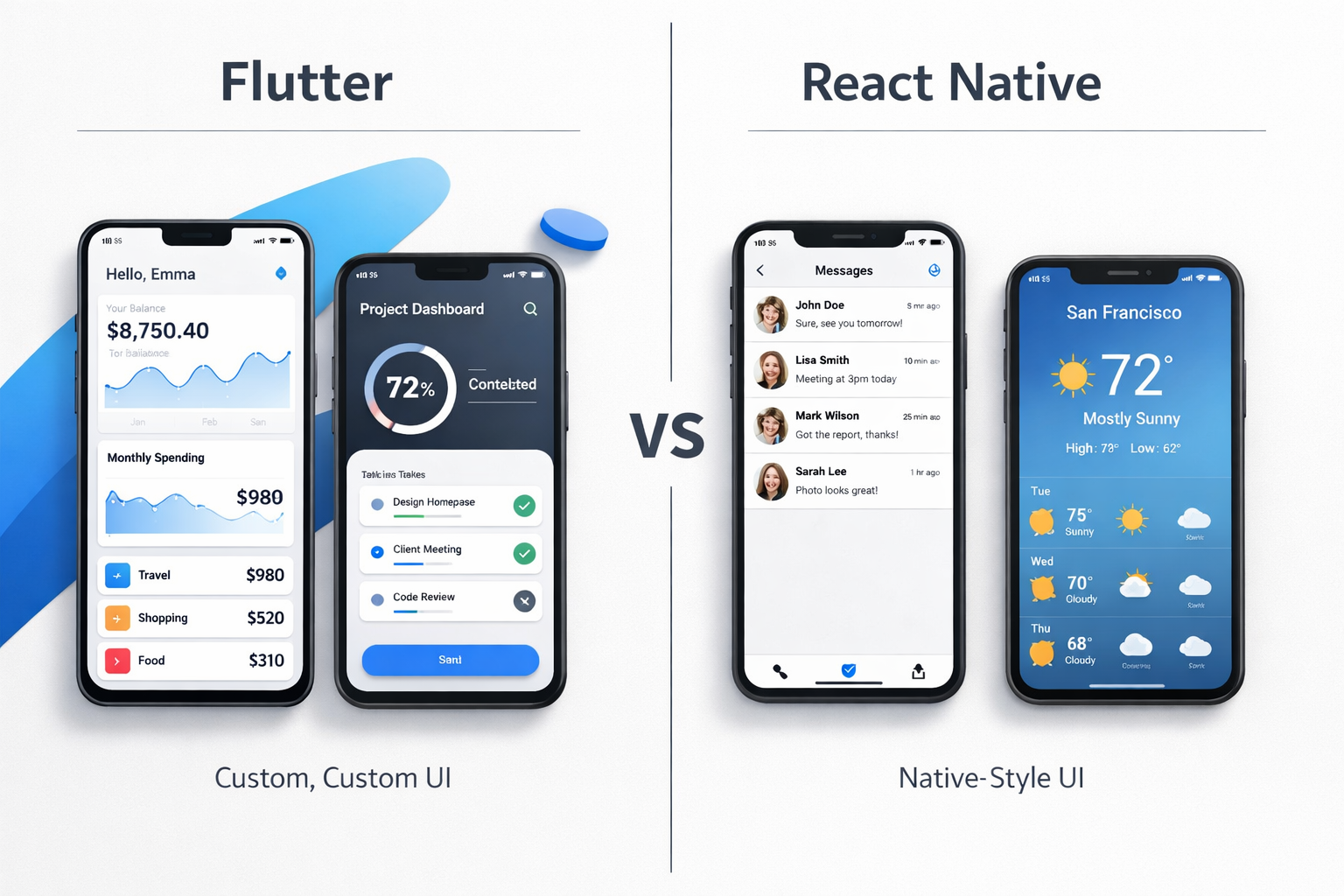
Flutter is an open-source UI toolkit created by Google. It uses a programming language called Dart and does not rely on native UI components from the operating system.
Instead, Flutter draws everything itself using its own rendering engine. This means every button, animation, and screen is controlled directly by Flutter rather than Android or iOS native elements.
Because of this, Flutter gives developers full control over how the app looks and behaves across all platforms.
In simple terms, Flutter is like a system where you design everything from scratch, but you get complete consistency everywhere.
This approach makes Flutter extremely powerful for apps that require custom UI, smooth animations, and an identical design across devices.
React Native
React Native, created by Meta, follows a very different approach. Instead of drawing everything itself, it uses actual native components from Android and iOS.
This means when you build a button or a list in React Native, it is converted into real native UI elements on the device.
In simple terms, React Native acts like a bridge between your JavaScript code and the mobile operating system.
Because it uses native components, React Native feels very familiar to web developers, especially those already working with React.
This makes it easier to adopt and faster to integrate into existing web-based teams.
Performance: Which One Feels Better in Real Use?
Performance is usually the first concern for most founders, and rightfully so. A slow app can ruin user experience, no matter how good the idea is.
However, in 2026, both Flutter and React Native have reached a level where they perform well for most use cases. The differences appear mainly in specific scenarios.
Flutter Performance Experience
Flutter is widely known for delivering smooth and visually stable performance. Because it does not depend on a bridge between code and UI, everything is rendered directly by its own engine.
This results in very consistent animations and transitions. Even when the app has heavy UI elements, Flutter tends to maintain stable frame rates.
It performs especially well in apps that have:
Complex animations
Highly custom UI designs
Fintech dashboards or trading screens
Media-rich interfaces
Another advantage is that Flutter reduces the chances of UI inconsistencies across devices, which is often a concern in cross-platform development.
Real-world Perspective
In practical terms, Flutter gives a slight advantage in UI-heavy applications, while React Native performs perfectly fine for most business-oriented apps.
For startups, this means performance should no longer be the only deciding factor.
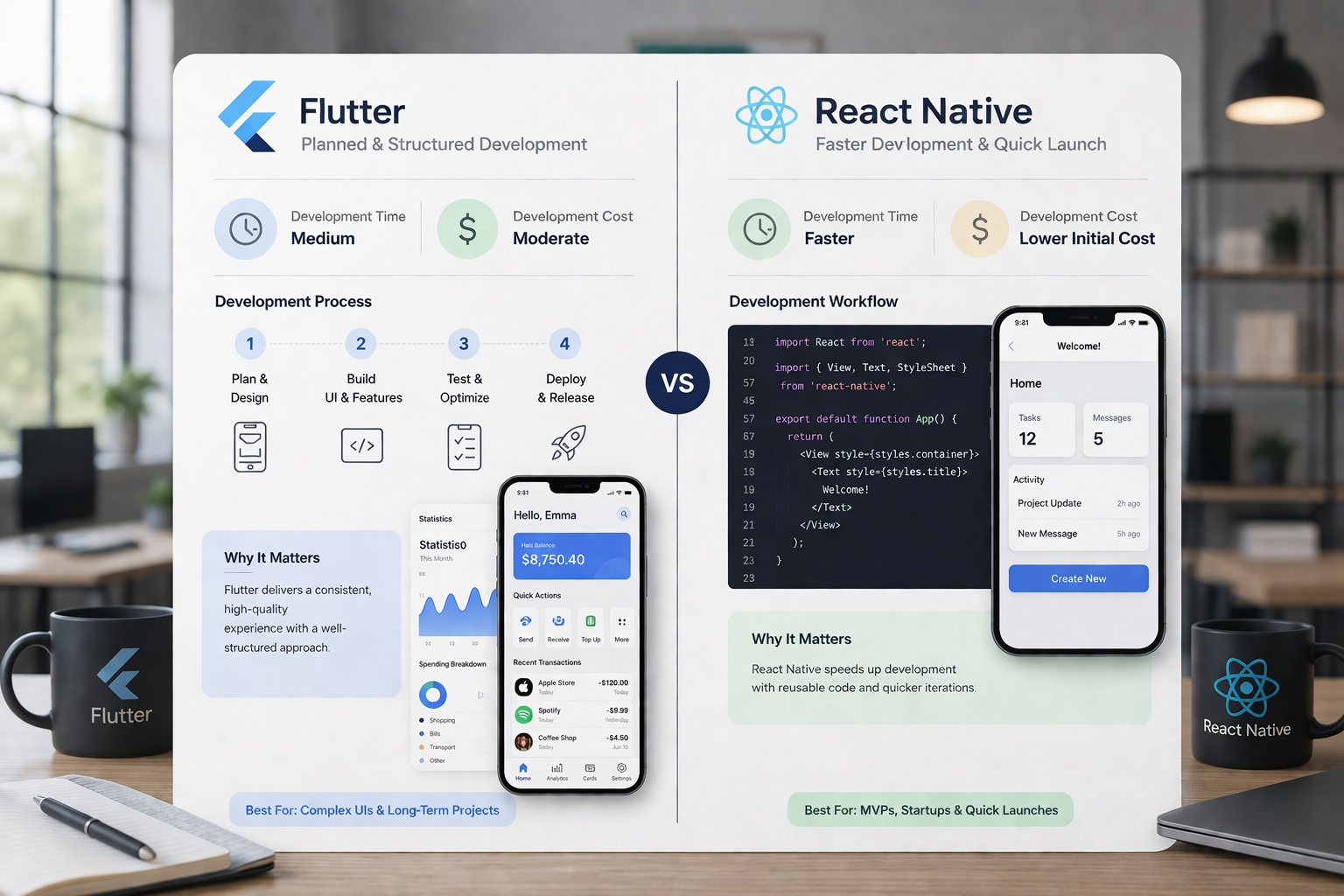
Flutter vs React Native development cost and speed comparison infographic with UI and workflow
Development Cost & Time to Market
For startups, this is often the most important factor after performance.
Even though both frameworks are open-source and free to use, the real cost comes from development time, hiring, and team efficiency.
Flutter in Real-world Projects
Flutter developers are slightly harder to find compared to JavaScript developers because Dart is not as widely used.
However, Flutter development often results in very polished and consistent user interfaces. Teams that specialize in Flutter tend to focus heavily on design precision and UI behavior.
This means you might spend a little more time or budget during hiring, but you often get a very refined final product.
React Native in Real-world Projects
React Native has a major advantage when it comes to hiring and speed of development. Since it is based on JavaScript, it is easier to find developers globally.
If your team already has experience with React for web development, you can reuse a lot of knowledge and even share logic between web and mobile.
This makes React Native extremely attractive for startups that want to launch quickly and validate their product idea in the market.
Ecosystem, Libraries & Community Support
Both frameworks have strong ecosystems in 2026, but they are built differently.
React Native benefits from the massive JavaScript ecosystem. Almost every major tool, SDK, or third-party service releases JavaScript support first. This makes integrations like payment systems, analytics tools, and authentication services very smooth and fast to implement.
Flutter, on the other hand, has a rapidly growing ecosystem backed by Google, offering thousands of packages and strong support for tools like Firebase and maps. If you're planning to build a scalable product using either of these technologies, working with the right mobile app development services can help you integrate features efficiently and launch faster.
Flutter is also expanding beyond mobile and is becoming more relevant in desktop applications, which adds long-term flexibility.
Hiring & Team Considerations
Hiring is one of the most overlooked parts of this decision, but it can have a huge impact on your startup’s speed.
React Native clearly wins when it comes to hiring availability. JavaScript developers are everywhere, and onboarding is generally faster, especially if your team already works with React on the web.
Flutter developers are fewer in number, but they often specialize more deeply in UI development and cross-platform architecture. Once trained, they tend to be highly productive and consistent.
For many startups, the decision here depends on urgency versus long-term quality.
Use Cases: When to Choose What
Flutter is a better fit when you are building products where design and visual experience matter deeply. This includes fintech apps, fitness applications, highly branded consumer apps, or tools that require consistent UI across platforms, including desktop.
React Native is more suitable when speed of development and ecosystem flexibility are more important. It works very well for MVPs, e-commerce platforms, SaaS dashboards, and apps that integrate heavily with web systems.
Final Verdict
There is no single winner in the Flutter vs React Native comparison in 2026. Both frameworks are powerful and capable of building scalable applications.
If your priority is design consistency and smooth UI, Flutter is a strong choice.
If your priority is faster development, easier hiring, and flexibility, React Native is the better option.
Final Thought
At the end of the day, choosing between Flutter and React Native is not about finding the perfect framework; it is about choosing the one that helps you move faster and build smarter.
Both technologies are more than capable of taking an idea from concept to a fully scalable product. The real difference will always come from execution, not just technology, and having the right partner like Innodify can make that journey faster and more efficient.
If you are still overthinking the decision, the simplest truth is this:
Don’t wait for the perfect choice. Start building, launch your MVP, and learn from real users.
Because in 2026, the speed of execution will always matter more than perfect planning.
Need Help Building Your App?
If you are planning to build a mobile app using Flutter or React Native and need help deciding the right approach, or want a team to build your MVP from scratch, we can help you.
We work with startups to build scalable and high-performance mobile applications, including:
Flutter & React Native App Development
MVP Development for early-stage startups
UI/UX design and product planning
Scalable architecture setup for long-term growth
Let’s turn your idea into a real, working product that is ready for users and built for scale.
Frequently Asked Questions
1. Is Flutter better than React Native in 2026?
There is no absolute winner between Flutter and React Native in 2026. Flutter is often preferred for apps that need highly custom UI, smooth animations, and consistent design across platforms. React Native, on the other hand, is better for faster development, easier hiring, and projects that rely heavily on JavaScript or existing web systems.
The better choice depends on your product type, team skills, and how quickly you want to launch your app.
2. Which is easier to learn Flutter or React Native?
React Native is generally easier to learn if you already know JavaScript or React for web development. Since JavaScript is one of the most widely used programming languages, many developers find React Native more accessible.
Flutter uses Dart, which is less common, but once you get used to it, the framework becomes very structured and easy to work with for building UI-heavy applications.
3. Which framework is faster for building an MVP?
React Native is usually faster for MVP development, especially if your team already has experience with JavaScript or React. The availability of developers and a large ecosystem of libraries helps speed up development.
However, Flutter can also be fast for MVPs if you have a skilled Flutter team, especially when your app requires a highly custom UI design.
4. Which performs better Flutter or React Native?
Flutter generally performs slightly better in UI-heavy and animation-rich applications because it renders everything using its own engine, which gives it very smooth and consistent performance.
React Native has improved significantly with its new architecture and performs extremely well for most standard apps like e-commerce platforms, SaaS dashboards, and social applications.
For most business apps, both frameworks are more than capable.
5. Can Flutter and React Native be used for large-scale apps?
Yes, both Flutter and React Native are widely used in large-scale production apps with millions of users.
Companies across the fintech, e-commerce, and social media industries use both frameworks in production. Scalability depends more on architecture, backend design, and optimisation rather than the framework itself.
6. Which is better for startups with a small budget?
React Native is often preferred for startups with a smaller budget because it allows faster hiring and quicker development using JavaScript developers, who are more widely available.
Flutter can also be cost-effective in the long term, but initial hiring and onboarding may take slightly more effort compared to React Native.
7. Should I switch from React Native to Flutter or Flutter to React Native?
In most cases, you should not switch once your app is already built or in development. Both frameworks are capable of building scalable apps.
Switching only makes sense if you are facing serious performance issues, hiring challenges, or long-term technical limitations. Otherwise, it is better to continue improving your existing app instead of rebuilding it from scratch.
8. Which framework is better for long-term product growth?
Both Flutter and React Native support long-term scalability. Flutter is often chosen for long-term design consistency and cross-platform expansion, while React Native is preferred for its ecosystem flexibility and easier team scaling.
The right choice depends on your long-term product vision and team structure.
Recommended for you

Top 7 Signs Your Business Needs a New Website
Is your website helping your business grow or driving customers away? An outdated, slow, or non-mobile-friendly website can hurt your credibility, reduce conversions, and lower your Google rankings. In this blog, we explore the top 7 signs that indicate it’s time to redesign or rebuild your business website. From poor user experience and slow loading speeds to weak SEO performance and low lead generation, these warning signs can directly impact your revenue.
Why Surat Businesses Need a Mobile App in 2026 (Real Examples)
Surat businesses across jewellery, restaurants, fashion and services are moving to mobile apps in 2026. Here is why, with real-world examples of how a business mobile app in Surat drives customer retention and growth.
10 Things to Check Before Hiring a Web Development Company in Surat
Hiring the wrong web development agency can cost you time, money, and rankings. Here are 10 things every business owner in Surat should check before signing a contract.