
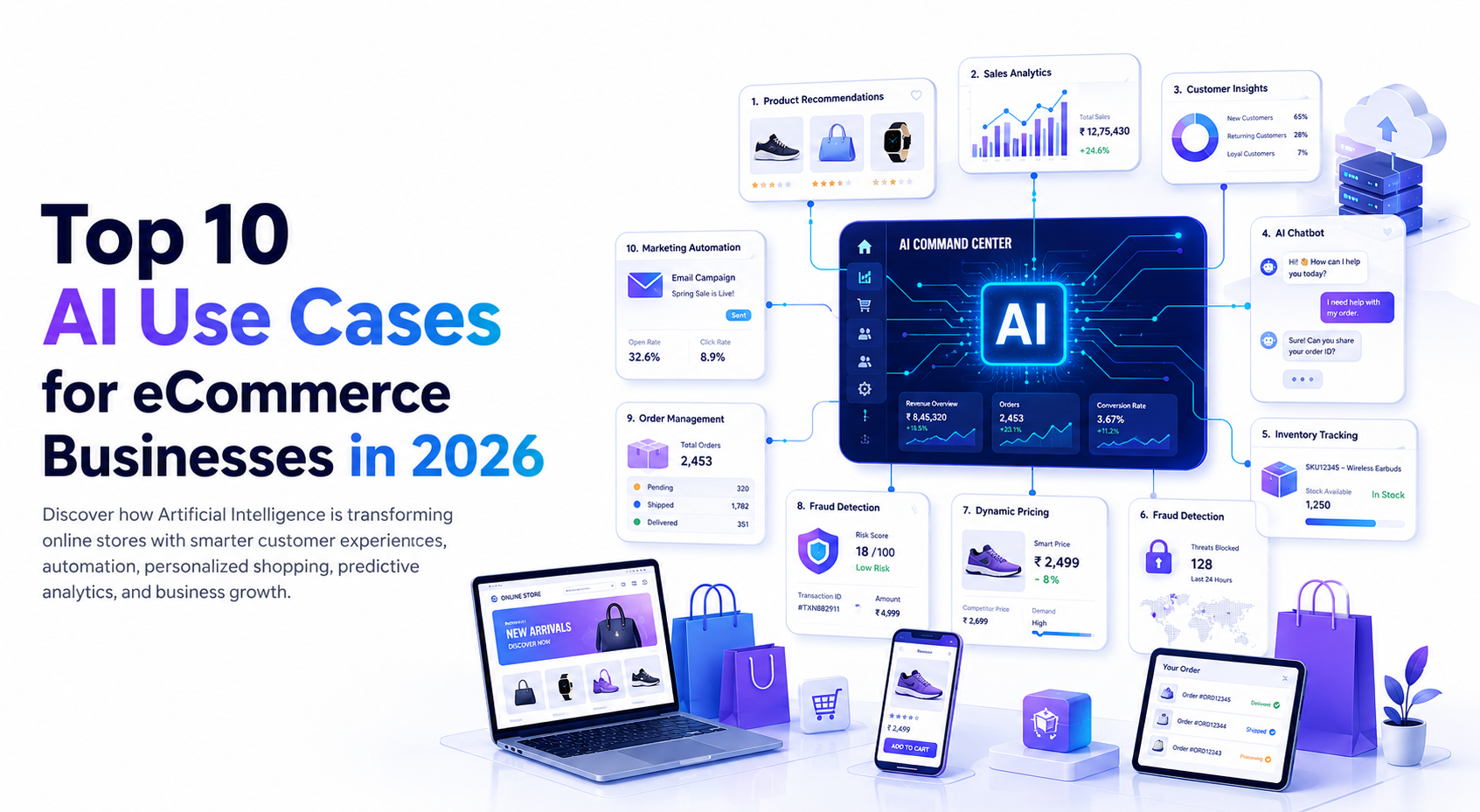
Top 10 AI Use Cases for eCommerce Businesses in 2026
Innodify Admin
Author
Introduction
Online shopping doesn't look the way it did even two years ago. Shoppers now expect stores to know what they want before they type it, chatbots that actually solve problems instead of looping them to a form, and prices, recommendations, and content that adjust in real time. Behind almost all of it is one thing: AI.
If you're running an online store in 2026, understanding AI use cases in eCommerce isn't optional anymore. It's part of staying competitive. Global research shows AI adoption in business has jumped sharply in the past year, with generative AI now touching nearly every function from marketing to supply chain. For eCommerce businesses specifically, this shift shows up in product pages, checkout flows, customer support, and even how stores get discovered by AI search engines like ChatGPT and Gemini.
This blog breaks down the top 10 AI use cases for eCommerce businesses in 2026. What they are, why they matter, and how you can start using them, even if you're running a small or mid-sized store.
If you're setting up or scaling an online store and want a foundation before adding AI on top, our guide on how to start an eCommerce business in India is a good place to begin.
1. AI-Powered Product Recommendations
Personalized product recommendations remain one of the most reliable ways AI drives revenue in eCommerce. By analyzing browsing history, past purchases, and real-time behavior, AI recommendation engines suggest products shoppers are actually likely to buy, not just popular items.
This is the foundation of "customers who bought this also bought" sections, personalized homepages, and smart upsell prompts at checkout. For stores selling multiple categories (fashion, jewellery, accessories), this alone can meaningfully lift average order value.
2. Generative AI for Product Descriptions and Content
Writing unique, SEO-friendly descriptions for hundreds or thousands of SKUs used to be one of the biggest bottlenecks in eCommerce content. Generative AI now drafts product descriptions directly from structured data, materials, dimensions, and features. Giving teams a starting point that a human can refine and approve.
This doesn't just save time. It keeps tone consistent across large catalogs and speeds up how quickly new products go live, which matters for stores running frequent collection launches or seasonal drops.
3. AI Chatbots and Virtual Shopping Assistants
Conversational AI has moved well past simple FAQ bots. In 2026, AI chatbots can handle nuanced product questions, guide customers through comparisons, recommend items based on context, and even complete purchases inside a chat window. Some brands report chatbot-driven upsells noticeably increasing sales, since the assistant nudges shoppers toward complementary products in the moment they're already buying.
For smaller teams, this means customer support doesn't have to scale headcount 1:1 with order volume.
4. Dynamic Pricing Powered by AI
Manual pricing based on quarterly reviews and gut feeling is becoming rare. AI-powered dynamic pricing adjusts prices in real time based on competitor pricing, demand spikes, inventory levels, and even individual shopper behavior.
Done well, this helps businesses capture the highest price the market will bear while staying competitive and clearing excess inventory through automatic, timely discounts rather than manual markdown decisions.
5. Visual Search
Visual search lets shoppers upload or snap a photo of a product they like and instantly find matching or similar items in your catalog. This is especially valuable for fashion, jewellery, and home decor stores, where customers often know what they want visually before they know how to describe it in words.
As mobile shopping continues to dominate traffic, visual search is quickly becoming an expected feature rather than a nice-to-have.
6. AI-Driven Demand Forecasting and Inventory Management
Overstock and stockouts are two of the most expensive problems in eCommerce. AI demand forecasting tools analyze historical sales, seasonality, and external factors to predict what you'll need to stock and when, often reducing inventory levels by 20–30% without hurting availability.
This frees up working capital that would otherwise sit frozen in unsold stock, and it reduces the "sorry, we're out of stock" moments that quietly cost sales.
7. AI-Based Fraud Detection
As transaction volume grows, so does exposure to fraud. AI fraud detection systems flag suspicious transactions in real time by analyzing patterns across location, device, payment behavior, and order history, catching issues faster and more accurately than manual review ever could.
For growing stores, this is one of the quieter but most important AI use cases, protecting margins without adding friction for genuine customers.
8. Personalized Marketing and Email Automation
AI now personalizes nearly every touchpoint in the marketing funnel, subject lines, product recommendations inside emails, retargeting ads, and even send-time optimization based on when a specific customer is most likely to open an email. This level of personalization increases engagement and moves shoppers toward checkout faster than generic, one-size-fits-all campaigns.
9. Automated Order Tracking and Returns Management
Post-purchase experience is a major AI use case in 2026. AI-powered systems now handle order status updates, delivery delay predictions, and return requests without a human agent needing to step in for every case. This reduces support tickets, shortens resolution time, and improves customer satisfaction after the sale. which matters just as much as the sale itself for repeat business.
10. Autonomous AI Shopping Agents
The newest shift in eCommerce is agentic AI systems that don't just answer questions but take action. These AI agents can compare products across a catalog, apply relevant discounts, complete multi-step tasks like changing an order, and in some setups, even handle checkout inside a messaging app. This is still an emerging area, but it's quickly becoming the difference between a store that automates support and one that automates entire customer journeys.
Why This Matters for Your eCommerce Business
You don't need to implement all 10 of these at once. Most successful stores start with one or two high-value use cases, usually product recommendations or chatbots, and expand from there as they see results. The key is having clean, structured product data and a website built to actually support these integrations, since AI tools are only as good as the systems they plug into.
This is where the technical foundation of your store matters. A store built on a modern, well-structured platform makes it far easier to add AI-powered personalization, chat, and automation later. If your current site isn't set up for this kind of scale, it may be worth a conversation about your web development foundation before layering AI features on top.
For businesses specifically building or upgrading an online store to support these AI-driven features, from product recommendation engines to automated inventory workflows. Our eCommerce development services are built around exactly this kind of scalable, AI-ready architecture.
Final Thoughts
AI in eCommerce isn't a future trend anymore. It's already running in the background of the stores your customers shop at every day. From personalized recommendations to autonomous shopping agents, the businesses that treat AI as a structured part of their operations, not a one-off experiment, are the ones seeing real gains in conversion, retention, and efficiency.
Start small, pick the use case that solves your biggest current bottleneck, and build from there. Whether that's a chatbot, smarter product recommendations, or a demand forecasting tool, the right starting point depends on where your store feels the most friction today.
Want help figuring out which AI use case fits your store first? Innodify works with eCommerce businesses to build the AI-ready foundation from web development to full-scale online stores that makes these tools actually work.
Frequently Asked Questions
1. What are the top AI use cases in eCommerce?
The most impactful AI use cases in eCommerce include personalized product recommendations, AI chatbots, dynamic pricing, visual search, demand forecasting, fraud detection, and automated marketing. Most businesses start with one or two of these before expanding further.
2. How is AI used in online shopping today?
AI is used across the shopping journey, from personalized homepage recommendations and AI-powered search to chatbots that assist during browsing to automated pricing and post-purchase support like order tracking and returns.
3. Can small eCommerce businesses use AI?
Yes. Many AI tools are available as affordable SaaS subscriptions or built-in platform features, making them accessible to small and mid-sized stores without needing an in-house data science team.
4. Is AI worth it for eCommerce stores?
For most stores, yes. especially when applied to high-friction areas like customer support, product content, or inventory planning. The return depends on having clean product data and a website architecture that can actually support AI integrations.
5. What's the easiest AI use case to start with?
Product recommendations and AI chatbots are typically the easiest to implement first, since many eCommerce platforms offer built-in or plug-and-play tools for both.
Recommended for you

Top 7 Signs Your Business Needs a New Website
Is your website helping your business grow or driving customers away? An outdated, slow, or non-mobile-friendly website can hurt your credibility, reduce conversions, and lower your Google rankings. In this blog, we explore the top 7 signs that indicate it’s time to redesign or rebuild your business website. From poor user experience and slow loading speeds to weak SEO performance and low lead generation, these warning signs can directly impact your revenue.
Why Surat Businesses Need a Mobile App in 2026 (Real Examples)
Surat businesses across jewellery, restaurants, fashion and services are moving to mobile apps in 2026. Here is why, with real-world examples of how a business mobile app in Surat drives customer retention and growth.

10 Things to Check Before Hiring a Web Development Company in Surat
Hiring the wrong web development agency can cost you time, money, and rankings. Here are 10 things every business owner in Surat should check before signing a contract.