
Top 10 Productivity Metrics Every Company Should Track in 2026
Innodify Admin
Author

Introduction
In 2026, businesses are no longer competing based on effort they are competing based on efficiency. Companies that succeed today are those that track, measure, and optimize their performance using data-driven strategies. This is where productivity metrics become a critical part of decision-making and long-term growth.
Many organizations still struggle because they focus on activity rather than outcomes. Teams may be busy throughout the day, but without proper measurement, it becomes difficult to understand whether that work is actually contributing to business success. This gap is exactly why modern companies rely on business performance metrics for growth and scaling.
With the rise of automation, AI tools, and remote work environments, tracking productivity has become both more important and more complex. Businesses now require productivity tracking software and intelligent systems to analyze performance in real time and make informed decisions. Companies looking to implement these advanced systems often partner with Innodify web development company to build scalable, data-driven solutions that improve efficiency and accelerate growth.
What Are Productivity Metrics?
Productivity metrics are measurable indicators that help businesses understand how efficiently their resources such as time, employees, and technology are being used to generate output. These metrics allow companies to identify inefficiencies, improve workflows, and maximize results without increasing costs.
In simple terms, productivity can be defined as output divided by input. However, modern businesses go beyond this basic formula by using multiple advanced metrics to evaluate different aspects of performance. These may include employee efficiency, revenue generation, customer satisfaction, and operational effectiveness.
By tracking the right metrics, companies can move from guesswork to data-driven decisions. This shift is essential for businesses that want to stay competitive in today’s fast-changing digital landscape.
Why Productivity Tracking Matters in 2026
The business environment in 2026 is highly competitive and technology-driven. Companies that fail to track their performance metrics risk falling behind competitors who are leveraging data and automation to improve efficiency. This is why adopting the best productivity tools making company operations smoother has become a necessity rather than an option.
Another major factor is the shift towards hybrid and remote work models. Managers can no longer rely on physical presence to measure productivity, which makes productivity tracking software essential for monitoring performance and ensuring accountability.
Additionally, AI-driven insights are transforming how businesses operate. With tools like ChatGPT, companies can automate repetitive tasks, generate content, and improve communication efficiency. This reduces workload while increasing output, ultimately boosting productivity across departments.
Top 10 Productivity Metrics Every Company Should Track
1. Revenue Per Employee
Revenue per employee is one of the most important business productivity metrics that companies should monitor. It measures how much revenue each employee contributes to the organization, providing a clear picture of workforce efficiency.
A higher ratio indicates that the company is effectively utilizing its human resources. This metric is particularly useful for scaling businesses that want to grow without significantly increasing operational costs. It also helps identify whether hiring more employees will actually lead to increased profitability.
2. Employee Productivity Rate
Employee productivity rate measures the output generated by each individual within a specific timeframe. This is a core component of productivity metrics and helps businesses evaluate individual and team performance.
Tracking this metric allows managers to identify high performers and areas where improvement is needed. It also helps in creating better training programs and optimizing workload distribution across teams.
3. Task Completion Rate
Task completion rate is a simple yet powerful metric that measures how many assigned tasks are completed within a given period. It provides insights into team efficiency, workflow management, and overall productivity.
A low completion rate may indicate issues such as poor planning, unclear communication, or lack of resources. By improving this metric, companies can enhance execution speed and achieve better results.
4. Employee Utilization Rate
Employee utilization rate measures how much time employees spend on productive or revenue-generating tasks. This metric is especially important for service-based businesses and agencies.
By tracking utilization, companies can reduce wasted time and ensure that employees are focused on high-value activities. This directly impacts profitability and operational efficiency.
5. Output Per Hour
Output per hour measures how much work is completed within a specific time frame. It helps businesses understand how efficiently time is being used across different processes.
This metric is particularly useful in industries like customer support, manufacturing, and digital marketing. Improving output per hour can significantly boost overall productivity without increasing working hours.
6. Customer Satisfaction Score (CSAT)
Productivity is not just about quantity, it is also about quality. Customer satisfaction score measures how satisfied customers are with your product or service.
A high CSAT score indicates that your processes are not only efficient but also deliver value to customers. This makes it an essential metric for long-term business success.
7. Time to Productivity
Time to productivity measures how long it takes for new employees to become fully productive. A shorter onboarding period means faster returns on hiring investments.
Companies can improve this metric by using better training systems, automation tools, and structured onboarding processes. This ensures that new hires start contributing quickly.
8. Planned vs Completed Work Ratio
This metric compares the amount of work planned with the amount actually completed. It helps businesses understand execution efficiency and identify gaps in planning.
If there is a consistent mismatch between planned and completed work, it may indicate unrealistic goals or poor time management. Fixing this can improve overall productivity.
9. Sales Growth Rate
Sales growth rate measures how quickly a company’s revenue is increasing over time. It reflects both productivity and market demand.
A steady growth rate indicates that your strategies are working effectively. This metric is crucial for businesses focused on scaling and expansion.
10. Customer Retention Rate
Customer retention rate measures how many customers continue to use your product or service over time. Retaining customers is often more cost-effective than acquiring new ones.
High retention rates indicate strong customer satisfaction and efficient operations. This makes it a key metric for sustainable growth.
Role of Productivity Tools and Automation
Modern businesses cannot rely solely on manual tracking methods. This is where digital marketing agency productivity tools and automation platforms play a crucial role. These tools help streamline operations, reduce manual work, and provide real-time insights.
AI-powered solutions are also transforming how businesses operate by improving customer engagement and boosting sales. For example, AI chatbots can guide users, answer queries instantly, and reduce drop-offs during the buying journey, which directly impacts conversions. learn how AI chatbots increase sales for eCommerce brands
Similarly, CRM systems and analytics platforms help track customer interactions and business performance metrics in one place. This integration ensures better decision-making and improved efficiency.
Similarly, CRM systems and analytics platforms help track customer interactions and business performance metrics in one place. Companies working with Innodify benefit from integrated systems that combine automation, data analytics, and scalable technology, ensuring better decision-making and improved productivity across all departments.
How Innodify Helps Businesses Improve Productivity
To effectively track and improve productivity, businesses need the right technology partner. This is where innodify web development company plays a vital role in helping companies scale through digital solutions.
Innodify offers a range of services designed to enhance business efficiency and performance. Their CRM development services help businesses manage customer relationships, automate workflows, and track performance metrics in real time.
Additionally, their web development services ensure that businesses have fast, responsive, and high-performing websites that support growth and user engagement. A strong digital presence directly impacts productivity and customer experience.
For companies looking to leverage advanced technology, Innodify also provides AI automation for business. These solutions help automate repetitive tasks, analyze data, and improve decision-making, making them essential for modern businesses.
Choosing the Right Productivity Metrics for Your Business
Not all metrics are relevant for every business. The key is to select metrics that align with your industry, goals, and team structure. For example, a digital marketing agency may focus on campaign performance and lead conversion, while a SaaS company may prioritize customer retention and churn rate.
It is important to track a combination of metrics rather than relying on a single indicator. This provides a more comprehensive view of business performance and helps identify areas for improvement.
Using the right tools and automation systems can make this process easier and more effective. This is why investing in business automation services in India is becoming increasingly popular among companies looking to scale.
Future of Productivity Metrics in 2026
The future of productivity metrics lies in automation and AI-driven insights. Businesses are moving towards systems that can track performance in real time and provide actionable recommendations.
Instead of manually analyzing data, companies are using intelligent platforms to predict trends and optimize workflows. This shift is making productivity tracking more accurate, efficient, and scalable.
With the integration of AI and automation, businesses can achieve higher efficiency with fewer resources. This is why adopting AI automation for business is no longer optional it is essential for staying competitive.
Conclusion
In 2026, success is defined by how efficiently a company operates rather than how much effort it puts in. By tracking the right productivity metrics, businesses can improve performance, reduce costs, and achieve sustainable growth.
From revenue per employee to customer retention rate, each metric provides valuable insights into different aspects of your business. The key is to use these insights effectively and take action based on data.
By combining the right metrics with powerful tools like productivity tracking software and expert solutions from Innodify, companies can unlock their full potential and stay ahead of the competition.
Frequently Asked Questions
What are productivity metrics?
Productivity metrics are measurable indicators that show how efficiently a business uses its resources like time, employees, and tools to generate output. They help improve performance and decision-making.
Why are productivity metrics important?
Productivity metrics help businesses identify inefficiencies, optimize workflows, and increase profitability. They are essential for business performance metrics for growth and scaling in 2026.
What are the best productivity metrics to track?
Some of the most important productivity metrics include revenue per employee, task completion rate, employee productivity rate, and customer retention rate.
How can productivity tracking software help?
Productivity tracking software helps monitor performance in real time, automate data collection, and improve accuracy. It allows businesses to make faster and smarter decisions.
What is AI automation in business?
AI automation for business uses intelligent tools to handle repetitive tasks, analyze data, and improve efficiency. Tools like ChatGPT help boost productivity.
How can Innodify improve productivity?
Innodify provides solutions like CRM development, web development, and AI automation to streamline operations and increase efficiency.
Recommended for you
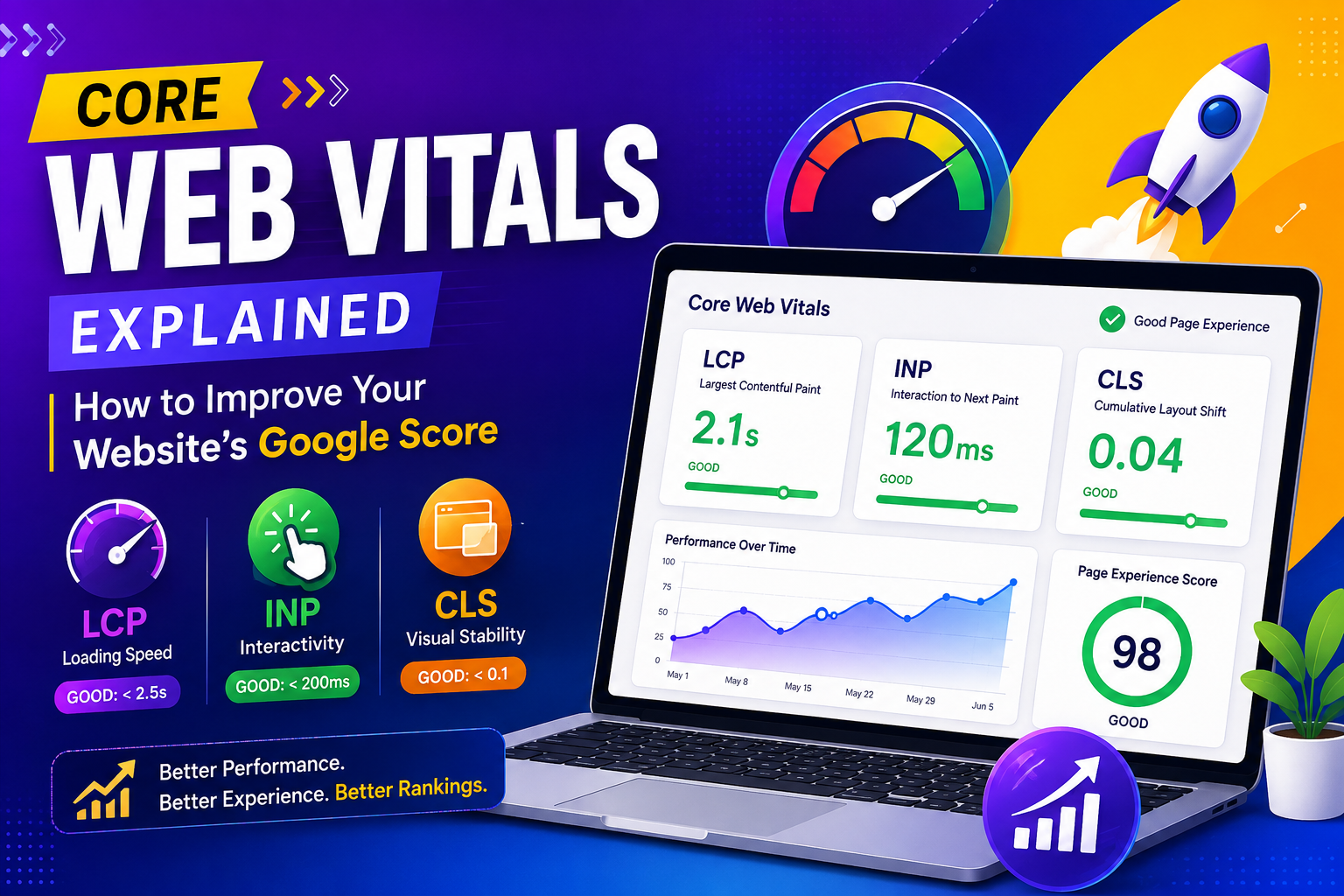
Core Web Vitals Explained: How to Improve Your Website's Google Score
Core Web Vitals are no longer optional. They shape how Google sees your website and how visitors experience it. This guide breaks down what these metrics mean, why they matter, and how you can improve your website performance score with practical, proven steps.

Top 7 Signs Your Business Needs a New Website
Is your website helping your business grow or driving customers away? An outdated, slow, or non-mobile-friendly website can hurt your credibility, reduce conversions, and lower your Google rankings. In this blog, we explore the top 7 signs that indicate it’s time to redesign or rebuild your business website. From poor user experience and slow loading speeds to weak SEO performance and low lead generation, these warning signs can directly impact your revenue.

Why Surat Businesses Need a Mobile App in 2026 (Real Examples)
Surat businesses across jewellery, restaurants, fashion and services are moving to mobile apps in 2026. Here is why, with real-world examples of how a business mobile app in Surat drives customer retention and growth.